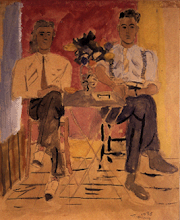
13.6.09

ΑΓΟΡΙΑ ΠΟΥ ΔΕΝ ΣΥΜΠΑΘΟΥΝ ΤΑ ΑΓΟΡΙΑ ΠΟΥ ΑΓΑΠΟΥΝ ΑΛΛΑ ΑΓΟΡΙΑ

Image Hosted by ImageShack.us
.
Αυτό το αγόρι αγαπάει τα αγόρια. Αλλά αυτό το αγόρι που αγαπάει τα αγόρια δεν αγαπάει τα αγόρια που δεν αγαπούν τα αγόρια που αγαπούν αγόρια.(…)

Gay Super Hero


Πέρασα αρκετά χρόνια μιας ανόητης ζωής με την επίμονη βεβαιότητα πως ήμουν θηλυπρεπής. Όχι ότι ξύπνησα ένα πρωί και την είδα ταραντέλα, κάθε άλλο. Απλά ως μικρός ήμουν πολύ επιρρεπής στο τι νόμιζαν οι άλλοι. Κοινώς τη μαλακία τους την έκανα Ευαγγέλιο και το προσκυνούσa. Τι περιμένετε, όμως, από έναν έφηβο που έψαχνε κι εκείνος να βρει τον εαυτό του μέσα σε έναν κόσμο που δεν καταλάβαινε; Μέσα σε μια επαρχία που είχε πολύ περιορισμένη προοπτική και που τα πάντα ήταν τόσο μα τόσο προκαθορισμένα που λίγα περιθώρια υπήρχαν για επαναστάσεις και νεωτερισμούς; Δεν είχαμε τότε και τις τηλεοπτικές ψυχολογικές εκπομπές της ιδιωτικής τηλεόρασης να μας ανοίγουν τα μάτια και να μας κλείνουν τα σπίτια. Τότε μόνο την ΕΡΤ είχαμε και είχαμε χορτάσει ντοκυμανταίρ και ελληνική ταινία το μεσημέρι της Κυριακής. Δεν είχαμε την Τατιάνα, την Όπρα, τη Ράνια Θρασκιά και την Άννα Δρούζα να μας ξεστραβώνουν. Για ζώδια και Άση Μπίλιου ούτε λόγος. Ήταν και ψιλοσατανικά όλα αυτά και αν το μάθαινε ο παπα – Τάκης θα μας έπαιρνε και θα μας σήκωνε. Έτσι το έκανε αυτός, όταν έπαιρνε ανάποδες έτριζαν οι πολυέλαιοι από τη γκαρίκλα κι έκανε και μια ώρα να τελειώσει το κήρυγμα και να περάσει στη Θεία Κοινωνία μπας και πηγαίναμε σπίτια μας. Τελοσπάντων.
Κάποια στιγμή, λοιπόν, μια μουρλοκακομοίρα καθηγήτρια της μουσικής είχε τη φαεινή ιδέα να φέρει κασετόφωνο (cd player δεν υπήρχε τότε) στο σχολείο και να μας βάλει να ακούσουμε τραγουδια κοινωνικού περιεχομένου, δηλαδή όχι Θέλξη (που δεν ξέρω και αν είχε γεννηθεί τότε) και όχι Αμαρυλλίς (που είχε γεννηθεί αλλά και η μάνα της ξεχνούσε πως την έλεγαν και την φώναζε “ψιτ”). Μας έβαλε, λοιπόν και ακούσαμε Φαραντούρη (από τότε την απεγχθάνομαι) και κάτι άλλες που πλατίνα δεν έκαναν ποτέ στη ζωή τους και σε κάποια φάση μας πέταξε και ένα σουξέ του οποίου το ρεφραίν έλεγε: “είναι κάτι παιδιά που δεν γίνονται άντρες, θα μπορούσαν να είναι παιδιά μας”. Μας ρώτησε μετά τη λήξη της ακρόασης σε ποιό φαινόμενο πιστεύαμε πως αναφέρεται το σουξέ και φυσικά, επειδή μπορεί να ήμασταν μικρά αλλά ήμασταν κι έξυπνα, απαντήσαμε ότι αναφερόταν στην ομοφυλοφιλία.
Τότε ήταν που έπιασα ένα μαλακισμένο, τον Αριστείδη, να με κοιτάζει με ένα παράξενο βλέμμα. Ήταν ο ορισμός του “σε κοιτάζω με μισό μάτι” και με ένα σαρδώνειο γέλωτα και υποβόσκουσα ειρωνεία. Γλοιώδες αν το πείτε, μέσα θα είστε. Το βλέμμα εκείνο υποννοούσε ότι ήμουν κι εγώ ένα από τα “χαρούμενα παιδιά” και η αλήθεια είναι ότι μου το είχε πει πολλές φορές ή μάλλον με είχε κατηγορήσει. Τότε θεώρησα πως ίσως είχε δίκιο διότι απλά τόσο εκείνος όσο κι εγώ μέσα μου, είχαμε παρεξηγήσει την ίσια τη συμπεριφορά μου. Βλέπετε, χωρίς να είμαι ταραντέλα μεν και χάιδω, ποτέ δε συμπάθησα εκείνη την αρούγκατη συμπεριφορά που έπρεπε να έχεις στην επαρχία για να θεωρείσαι φορέας αρχιδιών. Με άλλα λόγια ήμουν καλός μαθητής, ευγενικός, δεν πολυσυμπαθούσα το ποδόσφαιρο αν και το έπαιζα, πήγαινα τακτικά στην εκκλησία και δεν είχα μηχανάκι από τα 13 μου. Ούτε στις πουτάνες είχα πάει να αδειάσω το εφηβικό μου ψωλόχυμα, αφού ήθελα να το αδειάσω εκεί που εγώ θα αποφάσιζα. Μπορεί, λοιπόν, οι επιλογές μου να οδηγούσαν στο ίδιο φύλο, η συμπεριφορά μου ωστόσο δεν ήταν θηλυπρεπής αλλά ο Άρης έκρινε πως ήταν θηλυπρεπείς οι πράξεις μου. Μπορεί να μην κεντούσα στα διαλείματα και να μη δούλευα βελονάκι αλλά εφόσον δεν έκανα τις μαλακίες του 99% των παιδιών της επαρχίας, αυτόματα γινόμουν Ντάνα Ιντερνάσιοναλ στα μάτια τους.
Τώρα φυσικά αδιαφορώ, τότε όμως δεν αδιαφορούσα καθόλου. Και μπορεί να μιλώ με χιουμοριστική διάθεση, ωστόσο τα χρόνια εκείνα δεν ήταν καθόλου εύκολα. Η υποβολή από το Αριστείδιο βλέμμα ήταν τόσο ισχυρή που για χρόνια δεν δεχόμουν να βγω φωτογραφίες και βίντεο, από τρόμο μη και όντως είμαι θηλυπρεπής. Κάποια στιγμή, αυτό καταρρίφθηκε κι έκτοτε απολαμβάνω τις φωτογραφίες που βγάζω. Και αν θέλεις να μάθεις, Αριστείδη, είμαι κούκλος, όχι Μπίμπι Μπο!!

Profusion
.

12.6.09

1959. ΝΟΣΗΡΟΤΗΤΕΣ. ΜΙΚΡΗ ΑΝΑΤΟΜΙΑ ΤΗΣ ΑΝΩΜΑΛΙΑΣ

Image Hosted by ImageShack.us

εφημ. Ελευθερία, 4/3/1959

ΤΖΙΑΝ ΚΑΡΛΟ ΜΕΝΟΤΤΙ - ΣΑΜΟΥΕΛ ΜΠΑΡΜΠΕΡ 3. ΤΟ ΑΔΟΞΟ ΤΕΛΟΣ

Image Hosted by ImageShack.us
Francis Menotti - Gian Carlo Menotti
.
Εκείνη την περίοδο ήταν που ο Τζιαν Κάρλο συνάντησε τον Φρανκ Φέλαν και από τότε η επικοινωνία μας άρχισε να αραιώνει αισθητά, όλο και περισσότερο.
Με την οριστική μου απόφαση να γυρίσω στην Ελλάδα, πολλοί αναρωτήθηκαν γιατί εγκατέλειψα έτσι ξαφνικά τον Μενόττι. Όσο περνάνε τα χρόνια, αυτό το ακούω όλο και πιο συχνά, κάθε φορά που βρίσκομαι ανάμεσα σε παλιούς φίλους, ιδιαίτερα από ανθρώπους που τον αγαπούν βαθιά και νοιάζονται για εκείνον. Συγκρίνουν την ήρεμη ζωή που έκανε όταν ήμουν εγώ κοντά του, με τη μετέπειτα, όλο προβλήματα και άγχη, δίπλα στον Φρανκ Φέλαν και σημερινό υιοθετημένο γιο του, ονομαζόμενο πια Φράνσις Μενόττι!
Από τη στιγμή που έφυγα απ’ την Αμερική και άρχισα τη θεατρική μου σταδιοδρομία εδώ στην Ελλάδα και ειδικά όταν ο Τόμας Σίππερς αποφάσισε να παντρευτεί, ο Τζιαν Κάρλο θα πρέπει να ένιωσε ξαφνικά πολύ μόνος που οι δυο αγαπημένοι του φίλοι τράβηξαν ο καθένας το δικό του ανεξάρτητο δρόμο, μακριά απ’ αυτόν. Άρχισε να ζει όλο και περισσότερο δίπλα στον Σαν Μπάρμπερ που, όσο περνούσαν τα χρόνια, η συμβίωση μαζί του γινόταν πιο καταπιεστική και δύσκολη. Τα γράμματα και οι κάρτες του Τζιαν Κάρλο έφταναν το ένα πίσω από το άλλο και ήταν γεμάτα νοσταλγία και μοναξιά. (…)
Την ίδια περίπου εποχή θα γνωρίσει τον Φρανκ Φέλαν –χαϊδευτικά τον φώναζε Τσιπ-, έναν πρώην παγοδρόμο που φιλοδοξούσε να γίνει ηθοποιός. Στια αρχές ο Τσιπ φαινόταν πολύ κλειστός, σεμνός, αδύναμος και είχε έντονα σημάδια αλκοολισμού, κάτι που συγκίνησε ιδιαίτερα τον Μενόττι. Ήταν ο άνθρωπος που δε ζητούσε τίποτα από τον Τζιαν Κάρλο, παρά μόνο να βρίσκεται κοντά του και να τον συντροφεύει στα ταξίδια του, ένα είδος δικής μου αντικατάστασης νομίζω.
Με τα χρόνια, όμως, άρχισε σιγά σιγά να εκδηλώνει τις αληθινές του επιδιώξεις και να πετυχαίνει την πραγματοποίηση των σχεδίων και των στόχων που είχε στο μυαλό του.
Πρώτα έπεισε τον Τζιαν Κάρλο ότι του ήταν απαραίτητος και τον έκανε, με τις συκοφαντίες του, να απομυθοποιήσει τους πιο κοντινούς και αγαπημένους του φίλους. Άρχισε να τον απομακρύνει απ’ τον Τόμυ, τη Νόνη, την Καμίλα Πέτσιμπλαντ, τη Βαλλύ Τοσκανίνι, τη Λίντα Τζαλορέτι, τον Ραφ Ραβαϊόλι και φυσικά τον Σάμουελ Μπάρμπερ. Στην περίπτωση του Σαμ, τόλμησε και πέτυχε το ακατόρθωτο. Μέχρι τότε, κανείς δεν είχε ποτέ διανοηθεί να χωρίσει αυτούς τους δυο άνδρες και να διαλύσει μια συμβίωση πενήντα χρόνων. Μια φιλία ολόκληρης ζωής! Ούτε ο ποιητής Ρόμπερτ Χόραν που έζησε μαζί τους τα πρώτα δέκα χρόνια ούτε ο Τόμυ και, φυσικά, ούτε κι εγώ είχαμε σκεφθεί κάτι τέτοιο. Ο Τσιπ, όμως, επιδίωξε να τους διαμελίσει και να απομακρύνει οριστικά τον έναν από τον άλλο, αφού πρώτα κατάφερε να πουληθεί οριστικά αυτό το όμορφο και γεμάτο μουσικές αναμνήσεις σπίτι, «Capricorn». Στη συνέχεια έπεισε τον Τζιαν Κάρλο ν’ αγοράσει μιαν αριστοκρατική τεράστια έπαυλη του 13ου αιώνα στη Σκοτία, όπου λέγεται πως ήτανη κατοικία της Λουκίας ντε Λαμερμούρ. Ο Σαμ, τότε, υποχρεώθηκε να μετακομίσει και να κλειστεί σ’ ένα ψυχρό διαμέρισμα του Μανχάταν. Η θλίψη, η μοναξιά και η μελαγχολία τον κατέβαλαν και τον τσάκισαν ψυχικά και μετά από λίγα χρόνια πέθανε από καρκίνο. Είμαι βέβαιος πως δεν μπόρεσε ποτέ του να δεχτεί αυτόν τον χωρισμό και τη μόνιμη εγκατάσταση του Τζιαν Κάρλο στην Ευρώπη.
Θλίβομαι όταν σκέφτομαι πως ο Σαμ έφυγε μόνος και σίγουρα με το παράπονο πως δεν είχε τη συνεχή συμπαράσταση του Τζιαν Κάρλο. Αυτό άλλωστε φάνηκε στη διαθήκη του, όπου έγραψε πως στο νεκροταφείο της Πενσυλβάνια που είχε διαλέξει να τον θάψουν αγόρασε έναν άλλο κενό τάφο, ώστε να ταφεί δίπλα του και ο Μενόττι.

Νικηφόρος Νανέρης: Πριν τα σβήσει ο χρόνος (Καστανιώτης, 1997)

11.6.09

ΚΑΤ' ΟΙΚΟΝ

Image Hosted by ImageShack.us
At Home / A Domicilio (2008)
Dir.: Mariel Maciá
.
For a newcomer, a repressed literature professor, sex with a woman can be daunting. What better way to learn the art of expressing physical desire for another woman than to hire a prostitute? Over sushi dinner, white wine and soft music, the two women both reconsider the prejudices they have about themselves, and about one another.
.

Η ΕΞΟΜΟΛΟΓΗΣΗ ΤΟΥ ΑΝΤΩΝΑΚΗ

Image Hosted by ImageShack.us

Η εξομολόγηση του Αντωνάκη

«Χρόνια, τώρα, και χρονάκια γύριζα στους ξένους τόπους
μελετώντας, νύχτα μέρα, τις ψωλές και τους ανθρώπους,
αλλά μήτε στο Μαρόκο, μήτε και στη Χονολούλου,
δεν απάντησα, ποτέ μου, ψωλή σαν του Θρασυβούλου!
Τ’ είν’ εκείνη, βρε παιδί μου! Κόκκινη σα μπολσεβίκος,
πάντα ντούρα και βαρβάτη – και τι πάχος και τι μήκος!...
Για ψωλή καθώς εκείνη, κι όπως και του Αποστόλη,
είν’ ανάγκη να υπάρχουν ειδικοί, επίσης, κώλοι:
Ένας δε εκ των μεγίστων κώλων του παρόντος κόσμου,
άσσος μεταξύ των άσσων – είναι, πάντως, κι ο δικός μου!...»

Ναπολέων Λαπαθιώτης (1933)

ΑΠΟΨΕ ΑΓΑΠΗΣΑ ΤΑ ΜΑΤΙΑ ΜΟΥ

Image Hosted by ImageShack.us


Νάρκισσος με τον Κωνσταντίνο Κληρονόμο
Ένα ποίημα του Ναπολέοντα Λαπαθιώτη μελοποιημένο από τον Δημήτρη Μαραμή
από το ένθετο cd του Τετράδιου Ανθολογίας «Κυριακές μες στο χειμώνα,
Ρομαντικοί ποιητές του μεσοπολέμου» - εκδ. Σoκόλη - Κουλεδάκη

Απόψε αγάπησα τα μάτια μου
κοιτώντας τα μες στον καθρέφτη:
να 'ταν το φως, που μες στην κάμαρα,
τόσο λεπτά κι ανάερα πέφτει.

Να 'ταν το ρόδο τ' απριλιάτικο,
που τό 'xα βάλει στη γωνία
να μην το δω να παραδίνεται
στη βραδυνή την αγωνία;

Nα 'ταν αλήθεια το τριαντάφυλλο
που ξεψυxούσε στο ποτήρι
- ή κάποιοι πόθοι που με παίδευαν
και που είxαν απομείνει στείροι;...

το ρόδo που 'σβηνε, το πάθος μου,
το παραθύρι, που δεν κλείνω,
ή μήπως επειδή σε κοίταξαν
τόσο πολύ το βράδυ εκείνο;...

10.6.09

ΕΡΩΤΕΥΜΕΝΟΙ ΣΤΗΝ ΑΘΗΝΑ

Image Hosted by ImageShack.us
.
ΑΘΗΝΑ
Μάιος – Αύγουστος του 2003
Ο Αμπντέλ ήταν απαρηγόρητος. Καταριόταν την ώρα και τη στιγμή που είχε παρατήσει τον Όσκαρ για να πάει να ζήσει με μια γυναίκα χωρίς τίποτα το εξαιρετικό, ανάμεσα σε οπισθοδρομικούς ανθρώπους.
Τους πρώτους πέντε μήνες υπόμενε τη νέα του κατάσταση με αξιοθαύμαστη καρτερία. Από την πρώτη μέρα επαναλάμβανε πως χάρη σ’ εκείνον τον γάμο, η οικογένειά του είχε γλυτώσει την καταστροφή. Όμως, τον έκτο μήνα είδε με αξιοθρήνητη διαύγεια την κατάστασή του. Ναι, ήταν ο σωτήρας της οικογένειάς του όμως, με τίμημα να θαφτεί ζωντανός. Και επιπλέον, ένιωθε πως η ευημερία του Αλί Αλ-Μεγκράζι θα διαρκούσε λίγο, αφού ήταν βυθισμένος με γεροντικό πάθος στην λατρεία της ποίησης, στο χασίς και τις οδαλίσκες, και πολύ σύντομα θα χρεωκοπούσε για τρίτη φορά. Ήταν δίκαιο να θυσιαστεί από τα είκοσι πέντε του σ’ αυτή την απαίσια ζωή;
Ήταν αδύνατον ν’ αγαπήσει τη Λεϊλά, που ήταν όμορφη και άνοστη σαν κιθάρα χωρίς χορδές. Ο Αμπντέλ καταλάβαινε τώρα πόση σημασία είχε στη ζωή του ο Όσκαρ. Δεν ήταν μόνο η προσωπικότητά του, η συντροφικότητα και γ γενναιοδωρία του. Ήταν και ο κόσμος του, ο κοσμοπολιτισμός του, οι σχέσεις του με καλλιτέχνες της Αριστεράς, με άτομα δίχως προκαταλήψεις, ανθρώπους καλλιεργημένους, φίνους.
Τις τελευταίες μέρες, σ’ εκείνη τη τρύπα της Βεγγάζης, όπου κάτω από τη φοινικιά του Αμπντουλάχ απάγγελλε το Κοράνι ή μιλούσε για αγοραπωλησίες, πίστεψε αληθινά ότι θα έχανε τα λογικά του από τη μια στιγμή στην άλλη. (…)
Όταν στεκόταν μπροστά στο ταμείο για να πληρώσει, από τα μεγάφωνα ακούστηκε μια διαπεραστική φωνή που ανακοίνωνε τη λίστα αναμονής για μια πτήση προς Αθήνα.
Αθήνα, Αθήνα…
Σπρωγμένος από μία ακατανόητη δύναμη, έψαξε στο πορτοφόλι του και διαπίστωσε ότι ακόμα δεν είχε λήξει η προσωρινή άδεια παραμονής του στην Ελλάδα. Και σαν τον παχύσαρκο, που ύστερα από ένα χρόνο διαιτητικού ηρωισμού υποκύπτει μπροστά σε μια πολύχρωμη πίτσα αφήνοντας τη μυρωδιά από μοτσαρέλα και πεπερόνι να του τρυπήσει τα ρουθούνια ως την ψυχή, ο Αμπντέλ πλησίασε τα γκισέ των Ολυμπιακών Αερογραμμών και αγόρασε ένα εισιτήριο Ρώμη – Αθήνα – Ρώμη, στην τουριστική θέση.
Ύστερα από τρεις ώρες, στο αεροδρόμιο Ελευθέριος Βενιζέλος έπαιρνε τηλέφωνο και μάθαινε από τον τηλεφωνητή ότι ο Όσκαρ βρισκόταν στο Λονδίνο. Τα πόδια του άρχισαν να τρέμουν και τον έπιασε ταχυπαλμία. Ωστόσο, ύστερα από μερικά τηλεφωνήματα, εντόπισε τον Ουόρεν, ένα φίλο του Όσκαρ και του είπε πού θα τον έβρισκε.
Και το βράδυ κατάφερε να μιλήσει μαζί του.
«Θέλω να σε δω, έχω ανάγκη να …»
«Μ’ αγαπάς ακόμα;»
«Απελπισμένα, Όσκαρ» είπε και του ξέφυγε ένας λυγμός.

Ντανιέλ Τσαβαρία: Για τα μάτια σου (opera, 2007)
.
.

THE CELLULOID CLOSET 2


9.6.09

ΑΚΟΛΟΥΘΩΝΤΑΣ ΤΟ ΟΥΡΑΝΙΟ ΤΟΞΟ 5

Image Hosted by ImageShack.us Image Hosted by ImageShack.us
Image Hosted by ImageShack.us Image Hosted by ImageShack.us Image Hosted by ImageShack.us
Image Hosted by ImageShack.us Image Hosted by ImageShack.us
Zurich Europride 2009

ΤΡΙΑΝΤΑΦΥΛΛΑ ΚΑΙ ΦΡΑΟΥΛΕΣ

Image Hosted by ImageShack.us
.
Αιμίλιος Βάρνας: Τριαντάφυλλα και φράουλες (Νεφέλη, 2009)
.
Είμαι έξω...
…μόνος μου.
Το σπίτι του Μίλτου είναι κοντά στο σιδηροδρομικό σταθμό. Για να φτάσω μέχρι εκεί, αφού κατεβώ από το λεωφορείο, πρέπει να ανεβώ μια γέφυρα που περνάει πάνω από τις γραμμές των τρένων. Γέφυρα σιδερένια, παλιά. Κάνω πολλή φασαρία όταν την περνάω. Όλη η πόλη ακούει τα βήματά μου. Εκεί υπάρχω. Την αγαπάω, είναι ωραία. Ανεβαίνω, είμαι ψηλά, περπατάω, νιώθω υπέροχα. Σκέφτομαι τον Άνχελ, σκέφτομαι να πέσω στο κενό. Να φύγω τώρα που είμαι ευτυχισμένος… Να μην είμαι αχάριστος… Να μη ζητήσω περισσότερα… Να μη ζήσω τίποτε άλλο που να είναι μικρότερο, λιγότερο έντονο, λιγότερο όμορφο. Να μη ζητήσω τίποτε άλλο. Όσο έζησα, έζησα! Να φύγω τώρα! Να ήταν η γέφυρα πιο ψηλή… Να μη φοβόμουν τον πόνο… Να μην είχα αίμα…
«Ναι, σιγά!».
Μετράω τα σκαλοπάτια…

Θεσσαλονίκη, σήμερα. Μια ιστορία αγάπης ανάμεσα σ’ έναν Έλληνα και σ’ ένα Βούλγαρο δοσμένη με εικόνες που διαδέχονται ταχύτατα η μια την άλλη σαν τα καρέ κινηματογραφικής ταινίας. Φασαρία, άγχος, φυσικά φαινόμενα, κι οι άνθρωποι μέρος του ντεκόρ. Η μουσική ως μέσο έκφρασης και αμέτρητα τσιγάρα που βουλώνουν τα στόματα. Κυρίαρχος όλων ο χρόνος. Στο τέλος, ο αφηγητής αναρωτιέται: αυτό που κράτησε τόσο λίγο, μήπως ήταν τελικά πολύ;

Καλοκαίρι στη Θεσσαλονίκη. Ξαφνικές μπόρες και ανεμοστρόβιλοι. Δυο νέοι άντρες συναντιώνται και ερωτεύονται. Οι συνθήκες, ιδανικές για την ανάφλεξη του πάθους και την απόλαυσή του. Ο χρόνος, σύμμαχoς κι αυτός του έρωτα. Όμως ο χρόνος είναι ατίθασος, είναι άστατος, εκεί που μένει μετέωρος, εκεί αρχίζει να καλπάζει. Εκεί που συνδαυλίζει τον έρωτα, εκεί τον πυρπολεί. Γιατί; Πώς; Πότε; Αναρωτιέται ο αφηγητής, αναρωτιέται βασανιστικά, ώσπου να καταλάβει πως ένα πάθος δεν επιδέχεται εξηγήσεις, ερμηνείες. Ένα πάθος βιώνεται, κι αυτό είναι όλο.
Θαρραλέο και τολμηρό μέσα στην αλήθεια του, το πρώτο αυτό μυθιστόρημα του Αιμίλιου Βάρνα αφηγείται μια δυνατή ερωτική ιστορία ανάμεσα σε δύο άντρες. Τα κεφάλαια, πολύ σύντομα τα περισσό¬τερα, συντονίζονται με τη λαχανιαστή ανάσα των προσώπων, οι δρόμοι της πόλης ακούν τα βήματά τους, οι στίχοι των τραγουδιών εκφράζουν την αίσθηση και το συναίσθημα εκεί όπου οι λέξεις δεν αρκούν.

Ο Αιμίλιος Βάρνας γεννήθηκε το 1974 στη Θεσσαλονίκη όπου ζει κι εργάζεται. Είναι πτυχιούχος ιταλικής γλώσσας και φιλολογίας. Το Τριαντάφυλλα και φράουλες είναι το πρώτο του μυθιστόρημα.

THE CELLULOID CLOSET 1


The Celluloid Closet (1995)
Directed by
Rob Epstein - Jeffrey Friedman
Writing credits
Vito Russo (book) -Rob Epstein (story) and Jeffrey Friedman (story)
and Sharon Wood (story)

8.6.09

ΤΖΙΑΝ ΚΑΡΛΟ ΜΕΝΟΤΤΙ - ΣΑΜΟΥΕΛ ΜΠΑΡΜΠΕΡ 2. ΟΙ ΚΡΙΣΕΙΣ ΖΗΛΕΙΑΣ

Image Hosted by ImageShack.us
Samuel Barber - Gian Carlo Menotti
.
Όσο κι αν λάτρευε ο Σαμ τον Τζιαν Κάρλο, κι όσο κι αν ήταν φανερό ότι δεν μπορούσε να κάνει χωρίς αυτόν, ωστόσο η ανοδική επιτυχία και η καθιέρωση του Μενόττι από όπερα σε όπερα που συνέθετε άρχισαν να τον βασανίζουν και να τον κάνουν να νιώθει πως έχανε τα πρωτεία του χαϊδεμένου και ανερχόμενου μουσικοσυνθέτη. Ειδικά μετά απ’ την τεράστια επιτυχία του «Μέντιουμ», είχα ακούσει πως ο Τζιαν Κάρλο ήταν το πιο συζητημένο πρόσωπο στον μουσικό κόσμο της Αμερικής και κάθε τόσο δημοσιεύονταν η φωτογραφία του στα εξώφυλλα των μεγάλων περιοδικών «Τάιμ» και «Λάιφ».
Με την πάροδο των χρόνων, ο Σαμ γινόταν όλο και πιο καυστικός και πικρόχολος και εναντιωνόταν στις εκάστοτε φιλίες του Τζιαν Κάρλο. Πίστευε πως η φιλία τους θα ‘πρεπε να είναι αποκλειστικά μόνο για τους δυο τους και την κάθε νέα γνωριμία του Μενόττι την έβλεπε σαν έναν κίνδυνο και μιαν απειλή που παραγκώνιζε όλο και περισσότερο τη δική τους σχέση. Κάθε φορά που ο Τζοαν Κάρλο καλούσε τα Σαββατοκύριακα κοσμικούς ή διάσημους φίλους του στο «Capricorn», ζήλευε και γκρίνιαζε συνέχεια. Κλεινόταν στο στούντιό του και από πείσμα δεν εμφανιζόταν παρά μόνο τις ώρες του φαγητού.(…)
Ο Σαμ ποτέ δεν αποδέχθηκε το γεγονός πως ο Μενόττι είχε μεγαλώσει σ’ ένα περιβάλλον περιτριγυρισμένος από κόσμο και πολλούς συγγενείς. Οι οικογενειακές γιορτές, τα γεύματα και οι καθημερινές πολυπληθείς αυγκεντρώσεις στο πατρικό του σπίτι τον είχαν μάθει να αγαπάει τους ανθρώπους, να χαίρεται και να διασκεδάζει μαζί τους στις δεξιώσεις και στις συχνές συναντήσεις σε διάφορα σπίτια.
Με τον εκδηλωτικό χαρακτήρα και το ιταλικό ταμπεραμέντο του, ο Τζιαν Κάρλο κατάφερνε πάντα να γίνεται το επίκεντρο της βραδιάς και είχε μια μοναδική γοητεία και χάρη (…) Η γενναιοδωρία τους ξεπερνούσε τα όρια της λογικής μέχρι σφάλματος. (…) Τον έθελγαν πάντα οι αβοήθητοι και οι ταλαιπωρημένοι. (…) Πάντα τον βασάνιζαν και τον απασχολούσαν οι ανάγκες των συνανθρώπων του. Ασχολείτο ώρες ολόκληρες με τα καθημερινά προβλήματά τους και έκανε ουσιαστικές προσπάθειες να τους βοηθήσει όσο μπορούσε περισσότερο (…)
Αυτά βέβαια για τον Σαμ ήταν εντελώς ξένα και μακρινά και δεν μπορούσε να καταλάβει την ψυχοσύνθεση, τη μεγαλοψυχία και την ανιδιοτελή ανθρώπινη προσφορά του Μενόττι προς τους συνανθρώπους του.
Μεγαλωμένος ο ίδιος σ’ ένα συντηρητικό περιβάλλον και ως παραχαϊδεμένος μοναχογιός, είχε μάθει να συγκρατεί τα συναισθήματά του και να είναι συνήθως πολύ κλειστός απέναντι στους άλλους. Από φύση του ντροπαλός, με μιαν ανασφάλεια για τους ανθρώπους γύρω του και φοβερά αναποφάσιστος, σε σημείο που ήταν ανίκανος να αγοράσει έστω και μια γραβάτα αν δεν ήταν μαζί του ο Τιζαν Κάρλο για να του δώσει την τελική του γνώμη.
Ο Τζιαν Κάρλο ήταν ακόμη αυτός που διηύθυνε κι οργάνωνε τη σωστή λειτουργία του σπιτιού. Αυτός έδινε οδηγίες στο προσωπικό για ψώνια και κανόνιζε το καθημερινό μενού στα γεύματα. (…)
Είμαι βέβαιος πως στο χαρακτήρα του Σαμ είχε αναπτυχθεί ένα είδος σαδομαζοχισμού, γιατί κατά βάθος χαιρόταν αφάνταστα που ο Τζιαν Κάρλο είχε αγγίξει την κορυφή της δημοσιότητας με τις συνθετικές του επιτυχίες και τις κοινωνικές του συναναστροφές και αυτό το αποδείκνυε ανά πάσα στιγμή. Ήταν ο πρώτος που τον υπεράσπιζε και εναντιωνόταν με τους εκάστοτε επικριτές του. Συγχρόνως, όμως, μέσα στο σπίτι έκανε τη ζωή του Τζιάν Κάρλο δύσκολη και πολλές φορές αφόρητη.
Η αλήθεια είναι πως όταν τον έπιαναν οι κρίσεις ζήλιας, όσο κι αν προσπαθούσαν οι άλλοι ΄γύρω να δείχνουν κατανόηση και να συμμερίζονται την πικρία και την ανθρώπινη ζήλια του, ήταν στιγμές που δεν άντεχαν τις γεροντοκορίστικες εκρήξεις του. Πολλές φορές έφτανε τον Τζιάν Κάρλο σε τέτοιο σημείο, ώστε να αισθάνεται δυστυχής, και να διακατέχεται από τύψεις γι’ αυτήν τη συμπεριφορά του. Τον παρακαλούσε συχνά να ηρεμήσει και του έλεγε: «Για όνομα του Θεού, Σαμ, δεν αντέχω άλλο. Τι θέλεις από μένα και τους φίλους μου; Πάψε να με καταπιέζεις και να προσβάλλεις τους καλεσμένους μου». (…)
Δε χρειάστηκε ασφαλώς πολύς καιρός για να μπω κι εγώ στη λίστα των ανθρώπων που ο Σαμ ζήλευε και σύντομα άρχισε να μου κάνει τη ζωή δύσκολη.

Νικηφόρος Νανέρης: Πριν τα σβήσει ο χρόνος (Καστανιώτης, 1997)

ΣΑΝ ΕΚΟΙΜΗΘΗΣ ΠΛΑΪ ΜΟΥ

Image Hosted by ImageShack.us


Κρίση με την Αρλέτα
Ένα ποίημα του Μάνου Χατζιδάκι μελοποιημένο από τον Νότη Μαυρουδή
από το cd: Παιδί της γης

Κρίση την είπαν την στιγμή
σαν εκοιμήθης πλάι μου με χάρη
την ώρα που ξεχύθηκαν μ' ορμή
χίλια πουλιά να σκίσουν το φεγγάρι.

Κρίση την είπαν την πηγή
που πάνε τ' άστρα να λουστούν το βράδυ
να πιουν νερό, να χτενιστούν στη γη
και να πλαγιάσουν στης αυλής μου το πηγάδι.

Κρίση την είπαν την ορμή
που φτιάχνει η αγάπη μέσα στο λιβάδι
κι η αναπνοή σου γίνεται στιγμή
που μ' ακουμπά τ' αγέρι του Θεού σαν χάδι.

7.6.09

GAY ΜΑΓΕΙΡΙΚΗ 8. ΕΥΚΟΛΕΣ ΚΑΙ ΕΥΦΑΝΤΑΣΤΕΣ ΣΥΝΤΑΓΕΣ

Image Hosted by ImageShack.us

Αν υπάρχουν προτιμήσεις στην κρεβατοκάμαρα, γιατί όχι και στην κουζίνα;

ΜΙΑ ΑΛΛΗ ΕΥΡΩΠΗ ΕΙΝΑΙ ΕΦΙΚΤΗ

Image Hosted by ImageShack.us

6.6.09

ΤΟ ΦΙΛΙ

Image Hosted by ImageShack.us
Muhammad Qasim (Ιράν), 17ος αιώνας

Το φιλί με τον Νίκο Ξυδάκη
Ένα ποίημα του Γιουνούς Εμρέ σε μετάφραση Γιάννη Υφαντή, μελόποιημένο
από τον Λεωνίδα Μαριδάκη από το cd: Λεωνίδας Μαριδάκης - Αβάδιστα

Απ’ το φιλί ο κόσμος κρέμεται
Μες στο φιλί ανασαίνει.
Αχ, να μην κόψει το φιλί κανείς
Κι όλος ο κόσμος πέσει.

ΣΟΥΦΙ ΜΥΣΤΙΚΙΣΜΟΣ ΚΑΙ ΟΜΟΕΡΩΤΙΣΜΟΣ

Image Hosted by ImageShack.us
Riza-i Abbasi (Ιράν), αρχές 17ου αιώνα
.
Danielle Aberle, "Sufi Mysticism and Homoeroticism / God as the Divine Beloved"
(...) In most Islamic societies there is no separation between secular and religious law; the Quran is Divine Law, and it is both immortal and unchanging. This is true of the medieval Islamic period, and therefore Islamic doctrine dictated that homosexual acts must be outlawed. Yet it is difficult to gauge the tolerance of medieval Islamic society towards homosexuality or its acceptability.
In his book "The Arabian Nights: A Companion", Robert Irwin states that there is evidence "to suggest that in medieval Arabic society active homosexuality was regarded as an acceptable way of finding relief from sexual tension, but that passive homosexuals and those who cultivated effeminate traits were scorned" (Irwin, 168).
James T. Monroe, in his article "Abu Bakr's Naughty Son", asserts that there was no concept of homosexuality in medieval Islam, but that "Islamic jurisprudence adopts a more restrained attitude, according to which attraction toward members of one's own sex is viewed as entirely normal and natural," and that "since same-sex attraction is viewed as natural, surrendering to a natural temptation cannot make the individual abnormal - merely sinful. . . within the restricted limits of discussion set by Islamic law, there was no room for the emergence of delineation of a homosexual personality per se" (Monroe, 118).
Though homosexuality was supposedly forbidden by religious law, and Islamic society seemed outwardly to be restrictive and severe, homosexual acts seem to have been quite prevalent and even acceptable in society. This is seen in the story "Girls or Boys" from the "Arabian Nights", in which the lady Dahia and the old man al-Salihani argue whether boys or girls are preferable. Ironically, al-Salihani uses the Quran to support his view:
"The Koran says: 'Men surpass women because Allah has given them superiority'. .. These holy words prove once and for all that a woman is worth only half a man"-- (Mardrus, 410).
Despite al-Sulihani's assurance that the prophet approved of homosexual acts, it was against Islamic law; the desire, however, was not.
Homoerotic desire was seen as not only natural, but even as embodying the love relationship between God and man. The Sufis were especially enamored of love theology, and used homoeroticism in both their poetry and practice:
- beauty and earthly perfection were seen as physical manifestations of God's love as Creator;
- God's presence on earth could be contemplated through "nazar" (which is gazing upon a beautiful object and experiencing unfulfilled desire),
- which symbolized longing for union with the Divine.
It was also an ascetic practice: the denial of earthly and carnal desires in order to concentrate fully upon God.
Asceticism and rejection of earthly pleasures is a central aspect of Sufism, as the ultimate goal is God as center of every moment and experience of God's love. Sensual pleasures distract one from traveling the right spiritual path and they must be surrendered in order to focus upon God; the heart renounces the world and sacrifices all for devotion to God.
According to the anonymous thirteenth century Sufi author of "Clarifications for Beginners," God created humans so:
- they could know Him and
- God's creation makes His presence known.
As the Sufi shaykh, Junayd was asked: "What is proof of the Maker's existence?"
He replied: "Morning has freed me of need for a lamp" -- (Chittick, 66).Through earthly creation, God allows one attribute of His Essence to be known, as "when the Gnostic looks at the manifest dimension of the existent things, he sees nothing but manifestation and generous giving, for that is the presence of self-disclosure and the court of descent" (Chittick, 68).
Both asceticism and experience of God could be sought through unconsummated homoerotic desire, and the Sufis ritualized the gazing upon a beautiful, beardless youth as part of their spiritual practice. The youth was considered a shahid or witness of God's beauty on earth.
The sama, or gathering in which the nazar took place, was given a spiritual dimension by the Sufis, and the "musical gathering is the company of the faithful, the garden in which it takes place is Paradise, the drinking of wine is the intoxication of divine love, and the beautiful youth, who may be the cup bearer, is the Divine Beloved Himself (Wafer, 111).
The twentieth century orientalist Henry Corbin relates the Sufi practice oí nazar to the Mandean belief that each human being has a heavenly twin, and the two are united in death:
"When the human soul has completed its cycle of purifications and when the scales of Abathur Muzania bear witness to its perfect purity, it enters the world of Light and is reunited with its eternal partner:
I go towards my likeness
And my likeness goes towards me;
He embraces me and holds me close
As if I had come out of prison"
--
(Corbin, 33).
Corbin refers to the "true man, the man within man," that dwells within each human and who bears witness to human action and guides the human; through contemplation of the inner man, the human is "united with it to the degree that all his defects are effaced in it; it is the homologue of Perfect Nature, of the shahid as the form of light"-- (Corbin, 35-36).
Unity through contemplation is reflected in the Sufi nazar as through spiritual gazing upon beauty, the soul reaches a vision of light in which it realizes unity:
"Thus the 'witness in Heaven' is called the 'scales of the supersensory' ... the beauty of thebeing who is the witness of contemplation is likewise a means of weighing, since it proves thecapacity or incapacity of the soul to perceive beauty as theophany par excellence"-- (Corbin, 36).
Corbin's theory that the human reaches spiritual actualization through contemplation of the beauty of its heavenly twin is in accordance with Sufi love theory that asserts that humans have the capability to unite with the Divine within their own souls, for the Divine Essence is both within and separate from the soul. Thus the soul feels the agony of separation and emptiness before and sometimes after realization of the Divine Essence within.
Essential to Sufi love theory is the symbolization of God Himself as the Divine Beloved;the lover both longs and suffers for the Beloved, and this is expressed through remembrance of the lost Beloved. Through annihilation of Self the Sufi sought to experience ecstatic union with the Divine and reach the ultimate ecstatic state or wajid. Mystical experience is expressed through love imagery and ecstatic union is often depicted as sexual or as an amorous nuptial.
The Sufi shaykh Abu l-Husayn an-Nuri describes the vacillation between veiling and unveiling, the experience of union and separation:
"For twenty years I was between wajd and faqd. When I found my lord, I lost my heart, and when I found my heart, I lost my lord"-- (Sells, 113).
Mystical union necessarily resulted in both extreme joy and despair as one is a "love martyr," and dies a spiritual or even physical death for love of God, for it is only through death for ideal love that the soul is resuscitated. Love mysticism with God as Beloved was used by the Sufis to express the ineffable nature of humanity's relationship with the Divine. Medieval Sufi mystical verse often employs homoerotic imagery and symbolism in order to effect both emotive reactions and express theological beliefs of the nature of God.
The tenth century mystic Al-Husayn ibn Mansur Al-Hallaj experienced ultimate unveiling as he proclaimed that his spirit was united with God, to the point that he believed he was the supreme manifestation of God's presence on earth:
"I have embraced, with my whole being, all Your love, O my Holiness! You have manifested Yourself so much that it seems to me that there is only You in me! I examine my heart amidst all that is not You, I do not see any estrangement between them and me, and only familiarity between You and me!"-- (Massignon, 143).
Hallaj goes so far in his love theory to assert that Satan was the perfect lover of God, for when Satan was asked to bow down before Adam, Satan replies:
"Even if I am abandoned, abandonment will be my companion. How can it be abandonment while love is one? To you, praise in success, in the pure absolute for a servant of true heart who will bow to no other than you"-- (Sells, 275).
According to Hallaj, "Satan had, more than any other lover of God, sought to please, not God but the sublime idea that he had had of God, that men must imitate his example by pushing their desire for God further to breaking the Law" (Massignon, 171). In much the same way, Hallaj was the tragic lover of the Beloved; in his gory death and abandonment by God as a sacrifice, Hallaj achieved union with the Divine.
In his poetry, prayers, and anecdotes about his preaching, Hallaj portrays two visions of God as Divine Beloved: God as cruel, demanding, and jealous, and God as manifested in Hallaj's soul. With the joy of ecstatic union comes the agony of separation, and the realization that there is nothing without God within. Hallaj spoke of this intense fear of the Beloved when he told a gathered crowd to "save me from God. .. For he has robbed me from myself, and He does not return me to myself. . . I am afraid of His forsaking me. .. He will leave me deserted, forsaken, outlawed"-- (Massignon, 142).
God is spoken of in the terms of a human relationship, as Hallaj fears he will be "deserted" and "forsaken" like a lover that is too much in love with an indifferent beloved. The image is one of a cruel Beloved who so overwhelms the lover he loses all sense of self; the Beloved leaves the lover with the horror that He may withdraw and leave the lover utterly empty. The Beloved is also fiercely jealous, an element of human love that is considered a vice, and the Beloved punishes the lover by removing all love for him in the world. The lover will be hated and killed, but this pain and rejection will draw him close to the Beloved. The reward is immense, as Hallaj describes his experience of Divine Union:
"I am He Whom I love and He Whom I love is I,
We are two spirits indwelling in one body.
When thou seest me, thou seest Him,
And when thou seest Him, then thou dost see us both"
--
(Smith)
The claim that the Beloved had penetrated and suffused Hallaj's soul to the point that the two were indistinguishable rocked the orthodox community who demanded his death. Yet his extreme words truly embody the Sufi goal of passing from selfhood to God through love, an idea the orthodox community found disturbing and arrogant.
Human relationships were used as a symbol of Divine Love, and the twelfth century Sufi poet Farid ud-Din Attar used the famous homosexual lovers Shah Mahmoud and Ayaz in his "Conference of the Birds" to depict ideal love of God. When Ayaz is raised to kingship from slave by the king and commanded to lead armies in faraway lands, he says:
"What he commands I'll do, but in my heart
We shall not- for one instant- live apart;
And what have I to do with majesty?
To see my king is realm enough for me"
--
(Attar, 159).
Only love is true faith, and Attar continually expresses this ideal love through homosexual imagery. The believer must be a slave to God in love, and be completely overwhelmed with desire and madness for God, as the slave who proclaimed to love the king learned:
"I would have worn his livery, a king
Would have become his slave in everything-
But he resisted love, and it is right
That he should lose his head in such a fight"
--
(Attar, 95).
The two stories are both enclosed by tales or sermons that espouse the proper way in which to love God. The homosexual imagery is not erotic as it is not meant to describe spiritual rapture, but how to surrender oneself so completely to God that death is preferable to separation. The slave had to die because he could endure separation from God; he loved his own life, a mere earthly body, when God was supposed to be his very life, breath, blood, and center of his every living moment.
According to Attar, complete asceticism is necessary for those on the mystical journey, and in this way his writing is relatively orthodox. The carnal pleasure of homosexual acts does not come into play in Attar's use of the homosexual motif, for Sufis must pass from carnal love to love of God. There is no place for love of a created being in Attar's theology, as he chastises those who love worldly things:
"This love is not divine; it is mere greed
For flesh - an animal, instinctive need. …
All those who loved appearances will prove
Each other's enemies and forfeit love,
While those who love the absent, unseen Friend
Will enter that pure love which knows no end"
--
(Attar, 111).
Attar portrays earthly love as an animalistic craving for pleasure, and this love is selfish and impure. True pleasure only comes from the love of the "unseen," unmanifest Divine, for to attempt to encapsulate Divine Beauty in human form is crass. Through purification of the heart one reaches pure Love, and experiences God's uniqueness which is the very essence of tawhid. In Attar's writing, tawhid is not merely the belief in one God, but the experience of loving only God. As Ayaz would sacrifice all felicity for Shah Mahmoud, so must the Sufi devout all to God, and through this the soul is emptied of self and the soul reaches an inward consciousness. The Sufi appears to be a slave to God, yet true liberation is found in enslavement, as Ayaz says to his master:
"When generosity
Persuades my sovereign lord to glance at me,
My being vanishes in that bright light
Which radiates from his refulgent sight;
His splendor shines, and purified I rise"
--
(Attar 195-196).
The thirteenth century Sufi poet Shihab al-Din al-Suhrawardi wrote of the prophethood of passionate love, and he envisioned Divine union as a movement of the lower human soul towards the perfect Being of pure light. The lower is consumed by the higher through love; the Light of Lights feels only love for itself, but the lover is absorbed by this love:
"The experience of delight is nothing but the consciousness of perfection and completeness arising from the fact that it itself is completeness and perfection"-- (Suhrawardi, 7).
His poetry expresses the desire of the lover for God as both a painful separation which is sometimes rewarded with "tasting" the Beloved:
"The hearts of those who love you long for you
and take pleasure in the sweetness of reunion with you.
You have shown mercy on those lovers who have taken on themselves
the veil of affection; and passion is the reveler of secrets"
-- (Suhrawardi, 10).
The lover experiences unveiling and the attribute of God as Love, and though the lover's desire is misunderstood and judged, he must nonetheless pursue the Beloved. Suhrawardi asserts the Sufi belief of complete annihilation of Self, and expresses this annihilation through violent and painful love imagery:
"They take delight in nothing save remembrance of their Beloved . ..
They have attained the Presence; all traces of their own essence have vanished. . .
He has annihilated them and torn them from their selves;
He has parted for them the curtains of subsistence,
so that their spirits have become nothing"
--
(Suhrawardi, 12).
His poetry is reminiscent of Attar's assertion that one must only love God, yet his imagery is not of the gentle light that absorbs being, but a violent ripping of the self from the soul, leaving no trace of self, indeed leaving absolute emptiness behind. The image is more in tune with Hallaj's image of God as robbing him of his essence, and fearing utter nothingness if the Beloved withdraws.
Attar's homosexual love imagery usually portrays a royal man as God, and a lowly male slave as humanity, and the love is platonic and chaste; the love is seen as purely symbolic of how to love God rather than the embodiment of ecstatic experience. The lover slave symbolizes the faithful Muslim's complete submission to God and the way in which humans should be consumed only with love of God. Suhrawardi's use of homosexual imagery is much more esoteric; his poetry encapsulates the inexpressible experience of union. Other Sufi poets used more explicit homoerotic imagery to depict the lover's complete submission to the Beloved.
In the case of the thirteenth century Persian Sufi Jalalu'1-Din Rumi, the poetry may have expressed autobiographical elements through which the Essence of Divine Love was explored and interpreted. Rumi found the physical manifestation of the Divine Beloved in the human form of the Sufi dervish Shamsu'1-Din of Tabriz. Shams claimed to have transcended the position of lover and had become the beloved, which presupposes the experience of Divine union.
Passionately devoted to him when they lived together for two years, Rumi was even more devoted after Shamsu'l-Din's death when he began to write poetry. Rumi had two other significant relationships with males, the goldsmith Salah al-Din Zarkub, and his disciple Husam al-Din Chalabi. Rumi's poetry is an ambiguous celebration of human and Divine love, which may or may not have been consumated in reality with his male lovers. For Rumi, the natural love that humans share for each other was neither animalistic nor impure; it was imperative in order to show humans the way to love God. Rumi expressed his love of God through his love for Shams, who was to him the ultimate Sufi master and guide to Divine Love.
Rumi proclaims the Religion of Love through his poetry; for him, the supreme attribute of God is Love beyond all human notions of love. His poetry is thick with opulent imagery of lush gardens, wine, music, and beauty, all of which are used to personify love. The use of homoerotic imagery points to a passionate and intense longing for God, and an understanding of the nature of Divine Love:
Come! How much for a kiss from those precious rubies?
If a kiss costs a life, it still must be bought.
Since that kiss is pure, it is not suited for dust-
I will become a disengaged spirit, I will leave this body.. . .
Another mark is that mad desire for the lip of the Water of Life
makes Love stir up a thousand fires and furnaces every instant.
Still another mark is that the body, like the heart, runs after that kiss with haste.
It becomes slender and delicate like the Friend's lips-how marvelous!
Slenderness from the fire of a boundless Beloved!
--
(Chittick, Rumi 303)
The encounter between God and man is sensually physical; man's longing is depicted as sexual attraction to a body. Yet the poem clearly does not advocate carnality, as the human body must be sacrificed to receive the Divine Kiss. The body is mere dust, which is a potent reminder of the fall of Adam that condemned humankind to death. Rumi answers the question of how man, composed of earth, can aspire to touch, to caress, the Divine Face. The self must be annihilated for the soul to be passively changed by Divine Love, and the surrendering of the self must be an active effort towards union. The poem is charged with longing as Divine Love causes an unbearable heat, an image of the hell of separation, which is the physical sensation of desire. Yet the body is not entirely sinful as it too runs after the Kiss. Rumi's words are rooted in the sensuality of physical desire, and the soul itself is transformed physically to become like the "Friend's lips." His imagery is both unorthodox and verging on wrong belief, as passion overwhelms all other elements of faith.
In another poem Rumi writes:
"Thy Love has transformed every one of my hairs into a verse and a ghazal!
The ecstasy has made every part of me a vat of honey. . .
Last night, the Friend kissed me on the lips- otherwise,
Why should my words be so full of savor?"
--
(Chittick, Rumi 271-272).
Here Rumi describes the transformation that the spirit undergoes through Divine Union, and the profoundly spiritual experience is described with images of physical kissing, animals, and sweet honey. The poem continues:
The lovers lament like reeds, and Love is the flutist.
What marvellous things will Love breathe into this flute of the body!
The flute is manifest and the Flutist hidden- in any case,
my flute is drunk from the wine of His lips.
Sometimes He caresses the flute, sometimes He bites it!
Ah! I lament at the hands of this sweet-melodied, flute-breaking Flutist!
--
(Chittick, Rumi 272)
The image of the Beloved playing the lover like a flute is overtly sexual in nature, as the flute is both a phallic image and the body's connection to the Divine Breath. Rumi shifts all authority of voice to God; he is only the manifestation of the unseen Divine Will, and the Divine is the source of his words and inspiration. Wine imagery is a popular Sufi motif used to describe the experience of Divine rapture, as though Divine Love permeates every element of the mystic and influences all action. Wine, like homosexual acts, is forbidden by Islamic law, and use of the two motifs is a transgressive act in and of itself. Rumi exploits subversive carnal imagery by combining wine and homoeroticism, as the lover is intoxicated by the wine of "His lips" while he plays upon the lover. Once again, the Beloved is depicted as sometimes cruel, sometimes affectionate, with the agonizing bite juxaposed with the loving caress. Spiritual pain is described in terms of the physical, as is spiritual love. Rumi's words are rooted in the sensual, erotic, and lusty, yet they convey the spiritual lusciousness and abundance of the mystical relationship with God.
Sufi poets often appropriated the form of conventional, profane Arabic poetry and imbued the classical style with spiritual meaning. The thirteenth century Arabic Sufi Ibn al-Farid used traditional themes and allusions from the pre-Islamic Arabic nasib, or ode, to give shape to his ecstatic experiences. His poetry moves in the direction of the nazar in which he celebrates Divine beauty and rapture through anthropomorphic imagery of Divine beauty, which are sometimes of an explicitly homoerotic nature:
The sun's self, yea, and the graceful gazelle submit humblybefore his face as he gazes about him, and take refugueand shelter in his beauty. .. The harshness of hisheart rivals the tempered steel.. .Ice-cool are his deep-red lips, and sweet his mouth to kissin the morning. . . .Of his mouth and his glances cometh my intoxication; nay,but I see a vintner in his every limb-- (Wafer, 116).The sun is a prevalent image of the Beloved as the only nourisher and source of life for the lover, and Rumi used the sun to symbolize Shams as his only source of illumination and joy. Divine Beauty as light is also employed in Sufi imagery as a lightning flash that illuminates the lover's heart for a brief moment of spiritual realization; it symbolizes "ahwal", the state of constant change. Vulnerability is represented in the sentimental depiction of the gazelle that takes shelter in the safety of the Beloved, yet the Hallajian image of the demanding Beloved, who took away all earthly affiliations from Hallaj in order to draw him near, is present in the hardness of the Beloved's heart; the imagery vacillates between being enveloped by the Beloved's mouth and unrequited longing, with union portrayed as intoxication and the Beloved's mouth the source of "tasting." Ibn al-Farid used wine imagery to symbolize "the wine of the divine love, which the lovers have quaffed before the grapes were created (i.e., on the Day of the Covenant), and which intoxicates the whole world. . . and leads man like the North Star toward his eternal goal"-- (Schimmel, 275-276).The image of the mouth is sensual and inviting, and it suggests the physical presence of a shahid. As with Rumi, Ibn al-Farid is playing with two forbidden carnal pleasures, wine and homosexual acts, to envision spiritual truth outside of orthodox Islam. Ibn al-Farid embodies the Sufi belief that love was the highest spiritual truth, and was above orthodoxy and faith.
The supremacy of love is seen in the poetry of the thirteenth century mystic Fakhr al-Din Iraqi. He followed a group of qalandars to India, supposedly because he fell in love with a young man in their group. The qalandars were "wandering dervishes, who, given to wine and love and the 'satisfaction of the heart,' observed only the bare minimum of conventional religious practices, and were not interested in morality and custom, nor asceticism"-- (Wafer, 120).
Iraqi's poetry reflects overwhelming and passionate longing for the Beloved and he captures in poetic language the state of the true lover:
What man is there that, having eyes to see.. . did not yield
his soul and heart and body unto Him.
The heart cannot withstand His loveliness:
it steals away the mind, and cheats the heart.
That slender grace, that is His beauty's charm,
ensnares the hearts of spiritual men,
and His primeval lovers bear the mark
of servitude eternal to His love.
--
(Wafer, 121)
Again, there is the image of the ruthless Beloved that "steals" heart and mind and empties the soul until it is devoid of self. The poem embodies the triad of lover, love, and Beloved as self is annihilated in the lover and his very mind, essence, and body are consumed by love. Complete submission to the will of the Beloved moves one towards ecstasy, yet it is not faith, but Divine Beauty and Love that pull the mystic irresistibly to surrender and union.
The sometimes blatant disregard for orthodox practice and the celebration of Divine Beauty through carnal and homoerotic imagery was often the source of trouble for Sufis.Association of Divine Love with the word 'ishq, passionate love, was disturbing for orthodox Muslims, for the Divine was self-contained and would not experience desire for His creations.
The use of 'ishq to describe "Essential Desire" was introduced by the Basra Sufis, who believed that "God loves the soul.. . meaning that if He never restrains the soul, He always desires it, and makes the soul desire Him, and that He 'draws near' it through stages in a mental pilgrimage, in a gradual purification, whose schema can be constructed: as stages of an ascent toward God"-- (Massignon, 160).
The belief that God desires union is reflected in Rumi's poetry, as he writes:
"When the lightning of love has shot into this heart, know that there is love in that heart.
When love of God waxes in thy heart, beyond any doubt God hath love for thee.
No sound of clapping comes from one hand without the other hand"
--
(Nicholson, 122).
Sufis who believed in this theory were accused of giving anthropomorphic traits to God, who is ineffable and beyond all human emotion. Others believed that Sufi love theory reflected Manichaean ideas, and "worship of God by love is the sin of the Manicheans, the heretics par excellence who imagine that their souls are particles of the eternal divine light, imprisoned in the body, and that a magnetic attraction from the origin of this love will attract them to become united with their origin again"-- (Schimmel, 138).
It is easy to see where this accusation comes from when one examines the love theory embedded in the poetry of the Sufis.
Sufis who practiced nazar were also accused oihulul, incarnationism, or believing that
'"God is incarnate in or united with the beloved,' and justifying on these grounds their indulgence in not only 'gazing' but also in 'touching' and 'the act'" and they were thus "thought to be guilty of a double heresy, which combined the transgressions of idolaters and sodomites:'worshipping their minions and copulating with their idols'"-- (Wafer, 111).
With Sufi poets such as Rumi and Ibn al-Farid it is difficult to separate homoerotic imagery from physical reality; their historical stories lead one to believe that their use of homoeroticism was not merely an esoteric use of a poetic motif.
Secular poets often mocked the quasi-religious practices of some of the less ascetically inclined Sufis in lyrical parodies. Saadi of Shiraz parodies the claim to self-denial by the Sufis in his poetic tale of a hypocritical Sufi ascetic:
A learned Sufi's heart was once enraptured,
His reason by the face and ringlets captured.
Of a well-muscled, power wrestler boy. . .
He groped the boy's apple in hot pursuit,
To take his turn kissing the musky fruit.
He wished to get inside the grappler's crotch
And shoot his arrow to its very notch.
--
(Sprachman, 201)
Saadi plays off the description of mystical union as rapture; the Sufi is indeed consumed with desire for his beloved, but this time he is enraptured by a human boy. The portrayal of the ringlets and the beauty of the boy's body uses motifs from Muhammed's own description of the vision of God as a beautiful youth with abundant hair, yet the wrestler's body contrasts with the slender, graceful images in Sufi poetry. He is muscular and earthy, and his body is the clear result of physical work. The image of a wrestler carries with it the smell of sweat and physical display; he is the embodiment of carnal, empty lust. While Sufi motifs concentrate on the pure beauty of the Beloved, Saadi's imagery is bluntly sexual and unromantic. Instead of an ineffable Beloved who penetrates the lover in Divine union, the Sufi is overwhelmed with carnal lust and wants to penetrate the object of his desire, not merely gaze upon his beauty and contemplate the Divine.
The idea of the Divine Kiss is played with as the Sufi ironically kisses the "musky fruit," and the Sufi is fumbling with awkward, desperate lust to get inside the wrestler's "crotch." The phallic imagery of the arrow is neither subtle nor sensual, but a crass image of rigorous penetration.
Another secular poet, the infamous Abu Nuwas, was well-known for his own homosexual escapades and homoerotic poetry. He mocks the Islamic edict against the homosexual acts that were so prevalent in society, and he twists Islamic law to proclaim his own message of free-love:
Obey your passion and, in the early morning,
bring it a yellow wine spraying fire.
Make love to boys in their youth,
when their beards begin to sprout, and in ripe old age.
Sit down in every tavern, where wine and lovemaking are offered. . .
And if you are asked: "Is pederasty permitted at this time?
Say: "Of course!"
To keep souls away from what they love is a great sin...
In this way you will carry out the holy war.
--
(Wright, 12)
His poetry parodies Islamic law, as well as the Sufi doctrine of renunciation. Instead of submitting to God, one must submit only to passion. The Sufi ritual practice of nazar is meant to lead one to spiritual knowledge through contemplation, not result in lovemaking. Sufis are supposed to feel desire in order to learn to control the flesh, and through this control move towards annihilation of self and the shaking off of all earthly desire to reveal only desire for God.
Abu Nuwas mocks the Sufi use of subversive motifs to symbolize the mystical experience as he calls for all to partake in the forbidden pleasures of wine and homosexual acts. He suggests that what souls truly love is pederasty, while the Sufis claim the soul should only desire reunion with the Beloved. Yet these are the crimes that Sufis were often accused of committing; many preached abstinence while breaking the Quaranic edict against homosexual acts.
As homosexual acts and homoeroticism were popular themes in secular literature such as the poetry of Abu Nuwas and The Arabian Nights, it is not surprising that it found its way into Sufi theosophy and poetry. Yet the Sufi treatment of homosexual themes differs from both the Islamic doctrine that forbids homosexual acts, the culture that politely tolerates it, and the literature that celebrates homosexual intercourse between the requisite older male and beautiful youth. Despite the accusations of pederasty and hedonism, Sufi love mysticism did not exalt physical pleasure, but Divine Love. The practice of nazar and the symbolic richness of Sufi poetry point to an experience of the Divine Essence within and spiritual realization of God's beauty and generosity. Homoerotic motifs served to embody the perfect love in which the faithful submits and surrenders all will to the point of complete annihilation of man's essential self, and this love is symbolized as a deep, insatiable longing for the Beloved. The symbolism is in itself transgressive, yet it is the belief behind the homoerotic motifs that is truly subversive:
love of God surpasses all other elements of Islam. Love is the only true faith and all orthodoxy and ritual is empty without love.
The idea that love is the only path towards God and the essential foundation of humanity's relationship with the Divine is beautifully reflected in Rumi's sensual love poetry:
Love is that flame which, when it blazes up,
burns away everything except the Beloved. . .
You are God's lover, and God is such that when
He comes, not a single hair of you will remain. . .
In love with the spirit's King, how should the heart seek a kingdom?
Enraptured by His slender waist, how should the spirit seek a robe of honor?
--
(Chittick, Rumi 216-217)

5.6.09

ΧΙΛΙΕΣ ΨΥΧΕΣ Σ' ΕΝΑ ΚΟΡΜΙ

Image Hosted by ImageShack.us
Ali Muhammad (Ιράν), 16ος αιώνας

Χίλιες ψυχές σ’ ένα κορμί
με την Αναστασία Έδεν
Ένα ποίημα του Τζελαλαντίν Ρουμί σε μετάφραση Καδιώς Κολύμβα, μελοποιημένο
από τον Λεωνίδα Μαριδάκη από το cd: Λεωνίδας Μαριδάκης - Αβάδιστα

Α, πώς χωράει
ο αγαπημένος στην καρδιά μου
παρακαλώ σε νύχτα
πες του τα μυστικά μου

Χίλιες ψυχές σ’ ένα κορμί
Χίλιες σοδειές σ’ ένα δεμάτι
Χιλιάδες στρόβιλοι ουρανών
Στο μάτι μιας βελόνας

Α, πώς κοιμάται
ο αγαπημένος στην καρδιά μου
παρακαλώ σε νύχτα
πες του τα μυστικά μου

ΣΑΝ ΣΗΜΕΡΑ. ΦΕΝΤΕΡΙΚΟ ΓΚΑΡΘΙΑ ΛΟΡΚΑ. ΟΙ 4 ΜΕΓΑΛΟΙ ΕΡΩΤΕΣ ΤΗΣ ΖΩΗΣ ΤΟΥ

Image Hosted by ImageShack.us
Φεντερίκο Γκαρθία Λόρκα (5/6/1898 - 19/8/1936)
.
Νύχτα του άγρυπνου έρωτα
.
Ψηλά η νύχτα, η σελήνη, οι δυο μας ταίρι.
Έκλαιγα εγώ αλλά εσύ γελούσες.
Ήσουν Θεός και με περιφρονούσες,
η πίκρα μου αλυσοδεμένο περιστέρι.
.
Η νύχτα χαμηλά. Κρύσταλλο οδύνης,
έκλαιγες από μακρινές γωνίες.
Η θλίψη μου μια δέσμη αγωνίες
στην άστατη καρδιά σου, που μου δίνεις.
.
Η αυγή μάς βρήκε στο κρεβάτι πάλι,
τα στόματα σε βρύση παγωμένη,
αίμα που τρέχει δίχως να τελειώνει.
.
Ο ήλιος μπήκε απ' το κλειστό μπαλκόνι
κι άπλωσε το κλαδί του το κοράλλι
μες στην καρδιά μου τη σαβανωμένη.

Μετάφραση: Σωτήρης Τριβιζάς
.
Image Hosted by ImageShack.us
Σαλβαδόρ Νταλί
Image Hosted by ImageShack.us
Εμίλιο Αλαντρέν
Image Hosted by ImageShack.us
Ραφαέλ Ροντρίγκεθ Ραπούν
.
El romancero lorquiano
Los cuatro hombres del poeta
Atléticos, morenos, altos y más jóvenes, pero muy diferentes La desconocida y poco estudiada vida amorosa de Federico García Lorca esconde una historia parecida a la de sus propios dramas
LAS relaciones homosexuales de Federico García Lorca componen un romancero oscuro, un misterio del que sólo se conocen algunos testimonios y escasos documentos, pero lo cierto es que sentía verdadera pasión por aquellas personas a las que amó. En pocas ocasiones fue correspondido y no siempre eligió a la persona adecuada. Salvador Dalí, Emilio Aladrén, Rafael Rodríguez Rapún y Eduardo Rodríguez Valdivieso fueron, en algún momento, los hombres de su vida y de sus obras.
La familia García Lorca durante años evitó toda referencias a las inclinaciones sexuales del poeta, para evitar, según indicó Laura García Lorca, que «se confundiera su asesinato con un crimen sexual». La misma Laura reconoció que, pasados los años, la familia asumió el tema «con toda naturalidad».
SALVADOR DALÍ
El amor que no pudo ser
Federico García Lorca y Eugenio Salvador Dalí vivieron su particular 'Brokeback Mountain' en la España de los años veinte. Su relación trascendió la simple amistad. Se conocieron en 1922 en la Residencia de Estudiantes de Madrid (cuando tenían 24 y 18 años, respectivamente). Fue una gran historia de amor aunque nunca llegara a consumarse. Lorca, menos temeroso al erotismo, fue mucho más consciente del amor que sentía hacia su amigo. En cuanto Lorca lo vio se enamoró perdidamente de Dalí, pero éste no aceptaba su homosexualidad, entre otras cosas por la influencia de un padre muy severo, el notario de Figueras. Mantuvieron, a pesar de todo, una estrechísima relación personal y artística primero; y un complejo debate estético después, hasta 1928, cuando se produjo el alejamiento entre los dos.
Dalí había comenzado el servicio militar, pero tuvo tres meses de permiso que pasó con su amigo Federico entre Figueras, Cadaqués y Barcelona. En este momento llevaban más de un año sin verse y pasaron unos meses en íntima amistad.
Según el pintor, en mayo de 1926 el poeta intentó estar físicamente con él -quiso penetrarlo- y aunque Dalí se sentía halagado por el amor de Lorca, no accedió a sus deseos, ya que no se consideraba homosexual, lo que Lorca respetó siempre profundamente.
Dalí era muy crítico con la obra de García Lorca. Cuando se publicó el 'Romancero gitano', Salvador le dijo a Federico: «Tú eres un genio y lo que se lleva ahora es la poesía surrealista. Así que no pierdas tu talento con pintoresquismos». Y Federico le hizo caso; dio un golpe de timón a su obra y surgió 'Poeta en Nueva York'. Dalí se alió con Buñuel en 'Un perro andaluz', lo que le distanció de Lorca, que entendió que, con el título de la película, se referían a él. En esa época Salvador conoció a Gala en París.
Con todo, cuando los dos amigos se reencontraron en Barcelona, en el año 1934, ni el tiempo ni la distancia habían borrado esa relación. «Somos dos espíritus gemelos. Aquí está la prueba: siete años sin vernos y hemos coincidido en todo como si hubiéramos estado hablando diariamente...».
EMILIO ALADRÉN
La gran pasión
En 1928, Federico se desentiende en Madrid de la revista 'Gallo' hasta tal punto que será requerido por el director de la publicación vanguardista, su hermano Francisco García Lorca. Federico, aunque en su interior seguía estando atraído por el joven Dalí, se sentía estrechamente relacionado con el escultor Emilio Aladrén Perojo, que había ingresado en la Escuela de Bellas Artes en 1922, el mismo año que Salvador. Ocho años más joven que Lorca, Aladrén, nacido en 1906, era un chico llamativamente guapo, de cabello negro, ojos grandes y algo oblicuos que le prestaban un aire ligeramente oriental, pómulos marcados y temperamento apasionado.
Federico lo había conocido allá por 1925, pero intimaron en 1927. A Lorca le sedujeron el físico, encanto personal y aire «entre tahitiano y ruso», que decía la pintora Maruja Mallo, quien fue novia de Aladrén hasta que vino el momento en que Federico se lo «robó» sin más miramientos.
La mayoría de amigos de Lorca despreciaban a Aladrén como artista y persona, y consideraban que ejercía una influencia muy adversa sobre el poeta. A Federico le encantaba llevar a Emilio a fiestas y presentarlo como uno de los jóvenes escultores españoles más prometedores. La relación levantó los celos en algunos amigos del poeta y fue causa de escenas violentas.
Una joven inglesa llamada Eleanor Dove, llegada a Madrid como representante de la empresa de cosmética Elizabeth Arden, fue la causa de la ruptura de la relación entre el poeta y el escultor. Es el verano de 1928 y Lorca se ve sumido en una gran depresión, que le llevará a Nueva York. En esa época escribió una carta a José Antonio Rubio Sacristán, uno de sus amigos de la Residencia de Estudiantes, donde dice, entre otras cosas: «Ahora me doy cuenta de qué es eso del fuego del amor del que hablan los poetas eróticos y me doy cuenta, cuando tengo necesariamente que cortarlo de mi vida para no sucumbir».
Paradojas de la vida, Aladrén fue escultor y tuvo algún éxito haciendo bustos en bronce de prohombres franquistas. Murió prematuramente al finalizar la década de los años cuarenta.
RAFAEL RODRÍGUEZ RAPÚN
La gran atracción
Función especial de 'El amor brujo' en la Residencia de Estudiantes allá por 1933. Entre el público se encontraba un apuesto estudiante de Ingeniería, Rafael Rodríguez Rapún, 'el tres erres', que le decían. Nacido en Madrid en 1912, Rodríguez Rapún es de constitución atlética, buen futbolista y socialista apasionado. Hacía unos meses que se había incorporado a La Barraca. No era homosexual pero, según su íntimo amigo Modesto Higueras, acabó sucumbiendo de tal manera a los encantos lorquianos que no hubo vuelta atrás: «A Rafael le gustaban las mujeres más que chuparse los dedos, pero estaba cogido en esa red, no cogido, inmerso en Federico. Lo mismo que yo estaba inmerso en Federico, sin llegar a eso, él estaba inconsciente en este asunto. Después se quería escapar pero no podía... Fue tremendo».
Sólo se ha encontrado una carta cruzada entre Lorca y Rapún, la escrita desde la añoranza del poeta, en aquellos días a Argentina: «Me acuerdo muchísimo de ti. Dejar de ver a una persona con la que ha estado uno pasando, durante meses, todas las horas del día es muy fuerte para olvidarlo. Máxime si hacia esa persona se siente uno atraído tan poderosamente como yo hacia ti». Lorca regresa de Argentina y se retoma una relación que parece reforzada, porque cuando el poeta es invitado a Italia a un congreso teatral, la esposa de Ezio Levi, quien le cursó la invitación, le transmitió que podía «acudir con su esposa», a lo que Lorca le respondió que era soltero, pero que asistiría con su secretario personal, Rafael Rodríguez Rapún.
El poeta no dejó de querer a aquel muchacho, quien según algunos testimonios, como los de la escritora y esposa de Alberti, María Teresa León, quedó profundamente afligido al conocer la noticia del asesinato de Federico. Rapún recibió formación militar, paradójicamente en la localidad de Lorca, y dicen que se marchó a morir al frente del Norte, donde encontró a 'la flaca', el 18 de agosto de 1937, justo un año después que García Lorca.
EDUARDO RODRÍGUEZ VALDIVIESO
El 'amigo' de Granada
Fue el amigo granadino del poeta, y conservó sus cartas hasta su muerte, en 1997. Rodríguez Valdivieso, catorce años más joven que Lorca, era alto y apuesto, con ojos oscuros y una sensibilidad a flor de piel. Trabajaba a regañadientes en un banco granadino, amaba la literatura y era pobre e infeliz. Según Ian Gibson, conocer y enamorar a Lorca, ser amigo predilecto suyo durante aproximadamente un año, fue una de las experiencias fundamentales de su vida.
Se conocieron en febrero de 1932, en un baile de disfraces, en el Hotel Alhambra Palace. Él iba vestido de Pierrot y el poeta, de Dominó. Rodríguez Valdivieso recordaba que la fiesta duró hasta la madrugada: «... Se bebió tanto que, al día siguiente, pocos se acordaban de la pasada aventura».
Muestra de aquella relación es el contenido de una de las siete cartas que Lorca envió al granadino: «Recibí tu carta que contesto enseguida, muy contento de que te hayas acordado de mí, pues yo creía que casi me habías olvidado. Yo, como siempre, te recuerdo, quiero saber de ti y tener lazo de unión contigo».
El 18 de julio de 1936 Rodríguez Valdivieso visitó la Huerta de San Vicente para celebrar junto con su amigo la festividad de San Federico. Una de aquellas tardes terribles de guerra y represión Federico bajó de su dormitorio y le dijo que había tenido un sueño inquietante: un grupo de mujeres enlutadas enarbolaban unos crucifijos, también negros, con los que le amenazaban. (ideal.es)
.
Image Hosted by ImageShack.us

4.6.09

ΤΖΙΑΝ ΚΑΡΛΟ ΜΕΝΟΤΤΙ - ΣΑΜΟΥΕΛ ΜΠΑΡΜΠΕΡ 1. ΦΙΛΙΑ ΜΕ ΤΗΝ ΠΡΩΤΗ ΜΑΤΙΑ

Image Hosted by ImageShack.us
.
Πόσες και πόσες φορές δεν είχα ακούσει τον Τζιαν Κάρλο να διηγείται διάφορες ιστορίες από τα παιδικά του χρόνια και την πρώτη του επίσκεψη στην Αμερική. Για τη γνωριμία του με τον Σαμ, που έμελλε να εξελιχθεί σε μια φιλία, γεμάτη αφοσίωση και αγάπη, για την υπόλοιπη πορεία της ζωής τους.
Ο Μενόττι προερχόταν από μια κλειστή κάστα αριστοκρατικής κοινωνίας του Καντελιάνο, όπου οι περισσότεροι κάτοικοι της περιοχής είχαν μεταξύ τους κάποια συγγένεια. Η μητέρα του ήταν μια όμορφη, δυναμική και δεσποτική γυναίκα που λάτρευε τη μουσική και έπαιζε η ίδια με πάθος πιάνο. Εκτός από τη γενική παιδεία που φρόντισε να δώσει στα δέκα παιδιά της, επιπλέον προσπάθησε να τους εμφυσήσει και την αγάπη για τη μουσική. Επέμενε πως το κάθε ένα έπρεπε να μάθει κι από ένα μουσικό όργανο. Έτσι αργότερα έφτασαν να οργανώνουν στο σπίτι τους μουσικές βραδιές και τα παιδιά έπαιζαν τσέλο, βιολί, άρπα, πιάνο και συχνά έπαιρνε μέρος κι η ίδια.
Απ’ όλα τα παιδιά της όμως, αυτός που έδειχνε αγάπη και μεγαλύτερη κλίση στη μουσική ήταν ο Τζιάν Κάρλο, που μάλιστα στα επτά του μόλις χρόνια έγραψε την πρώτη του όπερα «Ο θάνατος του πιερότου». Η χαρά της ήταν απερίγραπτη και έκανε τα πάντα να τον ενθαρρύνει και να τον οδηγήσει στον κόσμο της μουσικής, μέχρι που του είχε και προσωπική δασκάλα πιάνου, η οποία τρεις φορές την εβδομάδα ερχόταν με το τρένο από το Μιλάνο. Αργότερα τον έγραψε στο μουσικό κονσερβατουάρ του Μιλάνου και κατάφερε να τον γνωρίσει με τον μεγάλο αρχιμουσικό Αρτούρο Τοσκανίνι. Αυτός, αφού διαπίστωσε το ταλέντο του Τζιάν Κάρλο, φρόντισε ο ίδιος να τον βοηθήσει να εισαχθεί στο «Ινστιτούτο Μουσικής Κέρτις» της Φιλαδέλφειας. Είχε πληροφορηθεί πως εκεί υπήρχε ένας σπουδαίος δάσκαλος στη μουσική σύνθεση και την έπεισε πως το παιδί της πρέπει να πάει στην Αμερική για ανώτερες μουσικές σπουδές. Η σχολή όμως ήταν πολύ αυστηρή και ο δάσκαλος Ροζάριο Σκαλέριο δε συνήθιζε να δέχεται ούτε ένα μαθητή πριν δει πρώτα ο ίδιος κάποια του σύνθεση, ακόμα κι αν τον σύστηνε ο μεγάλος Τοσκανίνι.
Έτσι η μητέρα του αποφάσισε να τον συνοδέψει στη Φιλαδέλφεια και αφού ο Σκαλέριο διαπίστωσε τις συνθετικές ικανότητές του, τον δέχθηκε για μαθητή του. Μετά η μητέρα του φρόντισε ώστε να μείνει με μια παραδοσιακή καθολική ιταλοαμερικανική οικογένεια, προκειμένου να μη λείψουν απ’ το παιδί της οι συνήθειες και οι παραδόσεις της πατρίδας του και επέστρεψε μόνη στην Ιταλία.
Ο ίδιος έλεγε πως ποτέ δεν μπόρεσε να ξεχάσει εκείνο το μελαγχολικό βροχερό σούρουπο που συνόδεψε τη μητέρα του στο τρένο. Όταν έφτασαν στο σταθμό κι ήρθς η ώρα ν’ αποχωριστούν, έπεσε ο ένας στην αγκαλιά του άλλου με λυγμούς. Μετά εκείνη έτρεξε και μπήκε στο τρένο, δίχως να γυρίσει να τον ξαναδεί.
Ξαφνικά ένιωσε, για πρώτη φορά στη ζωή του, τόση μοναξιά, που μόνο η παρουσία και η φιλία του Σαμ κατάφεραν να τον βοηθήσουν να ξεπεράσει τη θλίψη και τη μελαγχολία που τον είχαν καταβάλει. Ένιωθε, έλεγε, πολύ περήφανος που ο Σαμ Μπάρμπερ έγινε φίλος του και που κατά κάποιο τρόπο τον προστάτευε κάτω από τις φτερούγες του, γιατί ο Σαμ τότε ήταν το είδωλο της σχολής. Έπαιζε πιάνο εκπληκτικά, είχε μια μελωδική φωνή τενόρου και οι συνθετικές του επιδόσεις στη σχολή συγκαταλέγονταν ανάμεσα στις καλύτερες των σπουδαστών. Και στους τρεις αυτούς τομείς θεωρείτο ιδιοφυία και ήδη λάτρευαν το «Κουαρτέτο για έγχορδα» που είχε γράψει. Όλοι τον θαύμαζαν και ήταν ο χαϊδεμένος μαθητής της σχολής. Από την πρώτη τους κιόλας γνωριμία γοήτευσε ο ένας τον άλλον, ο Μενόττι με την ευρωπαϊκή παιδεία και το ιταλικό αριστοκρατικό ταμπεραμέντο, ο Σαμ με τη γοητευτική παρουσία και την αμερικανική μόρφωση. Έτσι δέθηκαν μεταξύ τους κι έγιναν αχώριστοι. Ο ένας συμπλήρωνε τον άλλον.
Ο Σαμ είχε μια αριστοκρατική παρουσία, που τον έκανε να μοιάζει με ευγενή Ευρωπαίο παρά με Αμερικανό. Αυτό βέβαια προερχόταν από το αυστηρό πουριτανικό περιβάλλον όπου μεγάλωσε, στο Ουεσττσέστερ της Πενσυλβάνια. Μέσα σε μια ευκατάστατη οικογένεια, ιδιαίτερα συντηρητική, πιστή στα αμερικανικά ήθη και έθιμα, όπου υπήρχε διάχυτη η ευγένεια και η μουσική παιδεία. Η θεία του ήταν η διάσημη κοντράλντο Λουίζ Χόμερ. Με την οικονομική βοήθεια που είχαν και οι δυο από τις οικογένειές τους, έκαναν πολλά και τακτικά ταξίδια στην Ευρώπη, ιδιαίτερα στη Γαλλία και την Αυστρία, που εκείνα τα χρόνια ήταν τα κέντρα των πιο σημαντικών μουσικών εκδηλώσεων και συγκέντρωναν τους δημιουργούς των τεχνών. Άρχισαν να κυκλοφορούν στα σαλόνια της υψηλής αριστοκρατίας και συναντούσαν γνωστούς διανοούμενους και σημαντικούς καλλιτέχνες. Απόκτησαν φιλίες με ξεχωριστές φυσιογνωμίες της εποχής, όπως ο Αρτούρο Τοσκανίνι, Μπρούνο Βάλτερ, Πικάσο, Ζαν Κοκτώ, Τσάρλι Τσάπλιν, Λόρενς Ολιβιέ, Μάρλεν Ντήτριχ, Ντμίτρι Σοστακόβιτς, Νταλί, πρίγκιπες, βαρόνους και πολλούς άλλους.
Τα πράγματα άλλαξαν, όμως, όταν ο Μενόττι άρχισε να έχει επιτυχία και να αναγνωρίζεται σαν συνθέτης (…)

Νικηφόρος Νανέρης: Πριν τα σβήσει ο χρόνος (Καστανιώτης, 1997)

Διαβάστε (υποχρεωτικά):
G-Musicology: Το coming out του μικρού Sam

ΗΠΑ. ΕΔΡΑ ΛΟΑΔ ΣΠΟΥΔΩΝ ΣΤΟ HARVARD

Image Hosted by ImageShack.us
.
Harvard to endow professorship in gay studies

By Tracy Jan (The Boston Globe, 3/6/2009)
Harvard University will announce tomorrow that it will establish an endowed chair in lesbian, gay, bisexual, and transgender studies, in what is believed to be the first professorship of its kind in the country.
Harvard President Drew G. Faust described the academic post as “an important milestone” in an ongoing effort by faculty, students, and alumni to raise the profile of LGBT studies at the university.
The university has received a $1.5 million gift from the Harvard Gay & Lesbian Caucus, a 4,900 member group, to endow the F.O. Matthiessen Visiting Professorship of Gender and Sexuality. Matthiessen, who Harvard says stands out as an unusual example of a gay man who lived his sexuality as an “open secret” in the mid-20th century, was an American studies scholar and literary critic at Harvard and chaired the undergraduate program in history and literature.
A growing number of colleges have begun offering academic programs related to sex, sexuality, and sexual orientation, though LGBT studies is a relatively young discipline. The City University of New York began the first gay and lesbian studies program in 1986.
“This is an extraordinary moment in Harvard’s history and in the history of this rapidly emerging field,” Mitchell L. Adams, a member of the Harvard Board of Overseers, said in a written statement. “And because of Harvard’s leadership in academia and the world, this gift will foster continued progress toward a more inclusive society.”
Adams is expected to announce the gift during the caucus’s annual commencement dinner tomorrow. The caucus, composed of alumni, faculty, staff, and students, was founded in 1984 to advocate for Harvard’s gay community.
The new professorship will allow Harvard to invite scholars studying sexuality or sexual minorities to teach in the Faculty of Arts and Sciences for one semester.
The visiting professorship will advance LGBT studies at Harvard by exposing students and faculty to cutting-edge ideas as leading thinkers rotate through the position, Harvard officials said, as well as help expand the field. It will also funnel new scholars to Harvard’s women, gender, and sexuality department.

Η ΔΙΚΗ ΜΑΣ ΕΛΛΑΔΑ ΣΤΑ ΓΑΛΛΙΚΑ

Image Hosted by ImageShack.us
.
INVERSES 9
Dossier sur la Grèce moderne
Olivier Delorme / Yannis Tsarouchis ou l'Eros en maillot de corps
Sophie Coavoux / La figure inversée du criminel dans trois poèmes inachevés de Constantin Cavafy.
Florian Fraissard / Le bruissement de la chair: esquisse d'une poétique des corps dans l'oeuvre de Cavafy.
Samuel Minne / Le désir en archipel: l'érotisme dans la poésie d'Olga Broumas.
Nikos Graikos & Yvan Quintin / Hadjidakis (1925-1994) et Christianopoulos (né en 1931)
Mirande Lucien / Sapho, l'héritage.
Patrick Dubuis / Le paradoxe grec de Cóstas Taktsis
.

Autres textes
Jean-Claude Féray / Renaud Icard, à la porte de deux mondes
Laurent Long et Jean-Claude Féray / Observations inédites d'Henri Jeoffrai sur la pédérastie en Chine.
Entretiens
Mirande Lucien / Entretien de Nathalie Gassel
Thierry Sarazin / Entretien de Jean-Paul Tapie
Jean-Paul Tapie / 375 dollars (nouvelle)
Actualités
Centenaire de la mort de Renée Vivien
Yvan Quintin: A propos des Kitharèdes de Renée Vivien.
Annuaire 2008: La liste des livres et les recensions.


3.6.09

ΟΙ ΟΜΟΦΥΛΟΦΙΛΟΙ ΣΤΗ ΖΙΜΠΑΜΠΟΥΕ

Image Hosted by ImageShack.us
.
BULAWAYO – (Busani Bafana - Inter Press Service News Agency (IPS), 13 May 2009): Zimbabwe is trying to rebuild itself as a nation where rights to freedom of expression and association are protected. Amongst the chorus of voices raised in support of a new constitutional order are the country's gays and lesbians.
Sexual acts between men are still illegal in Zimbabwe; the absence of constitutional protection for lesbians makes them equally vulnerable to discrimination and prosecution.
Gays and Lesbians of Zimbabwe (GALZ) director Keith Goddard spoke to IPS correspondent Busani Bafana about the challenges faced by marginalised groups that his organisation represents.
IPS: Has the situation of gays and lesbians changed since the public showdown in which your stand at the Zimbabwe International Book fair was closed down many years ago?
Keith Goddard: There is a difference between government's campaign against gay and lesbian people and the attitudes of the general public. ZANU-PF maintains its anti-gay stance although it is rare for anyone in the party these days to speak out against lesbian and gay people. It must be over a year since President Robert Mugabe even mentioned the subject.

Homophobic attitudes are common amongst members of the general populace but we have seen a gradual shift in attitudes with more and more people becoming either accepting or at least tolerant of gay people, especially in urban areas.
IPS: What are the prospects for change now that there's a new government in place?
KG: With the Government of National Unity, we now have a number of people in parliament who are gay-friendly. This could be an opportunity to engage with the government on issues affecting marginalised groups such as GALZ and ensure that government supports our call for specific mention of sexual orientation in Zimbabwe's next constitution.
Until debate on this matter is reopened, we have no means of assessing if the situation is likely to change. GALZ will support a process that is people-driven and incorporates various fundamental rights including the right to one's sexual orientation.
IPS: What are some of the immediate challenges?


KG: Although I have said there is growing tolerance, most of our members still fear to tell their families and friends that they are gay. There is a small but growing number who are coming out of the closet.
Gay and lesbian people face the same challenges as our heterosexual counterparts when it comes to economic opportunities, education, health, housing etc. Although when it comes to housing, there have been times when a landlord has evicted or tried to evict a tenant because he or she is gay.
In a surprising move, the National AIDS Council (NAC) Strategic Plan for 2006- 2010 specifically mentions the need to remove punitive measures against men who have sex with men because it drives this vulnerable community underground and makes them difficult to target with HIV/AIDS interventions.
The plan calls for research into MSM and HIV in Zimbabwe and the NAC is now part of the team which includes GALZ which intends to conduct this research. This is a big step forward.
IPS: What policies discriminate against gay and lesbian rights?


KG: Rambling, vocal rhetoric against gay people does not constitute a policy. Government also cannot outlaw rights in Zimbabwe. Human rights are inalienable and cannot be given or withdrawn.
Being gay or lesbian is not a crime in Zimbabwe: only sexual acts between men are illegal although government has made the definition of a sexual act very broad indeed and it could even be extended to hugging or holding hands in public.
IPS: What is your organisation doing to highlight and push for these rights?


KG: There is little or nothing in our law that we can use to challenge homophobic legislation in the courts. We are preparing ourselves for a possible fresh national constitutional process in which we will push for the inclusion of sexual orientation.
We
 have done much over the past ten years or so to embed ourselves in the various networks of NGOs and we are now starting to persuade them to mainstream gay and lesbian issues in their work.


IPS: How are gays and lesbians coping in Zimbabwe?
KG: Although there are added difficulties facing gay and lesbian people in Zimbabwe, the major problems we face are those we share with the vast majority of the population: fear of government oppression if you are a member of an unpopular minority or opposition political party, hunger, unemployment, poverty and lack of shelter and clean water.


IPS: How big is the gay and lesbian community in Zimbabwe?
KG: We have no idea because the vast majority of gay and lesbian people are obviously in the closet given the general prevailing attitude of disapproval and the attitude of powerful members of government.


ΟΙ ΟΜΟΦΥΛΟΦΙΛΟΙ ΣΤΗΝ ΑΓΚΟΛΑ

Image Hosted by ImageShack.us
.
ANGOLA – (IRIN News, 2008): It was a wedding that pulled out all the stops, including a party at the Marine Club on the island of Luanda and a five-star nuptial night at the Hotel Presidente Meridien.
The ceremony didn't go unnoticed by Angola's newspapers. "Shameless," screamed the cover of one of the country's weekly news magazines. "Abominable," read the headline of another.
Angolan couple, Bruna and Chano paid a high price for making their homosexual relationship public.
The two young men met when they were both living in the Luanda neighbourhood of Bκs. After seeing each other for three and a half years, they decided to hold a ceremony to make their relationship feel official, although doing so legally was not an option.
On May 6, 2005, 21-year-old Aleksander Gregσrio (Chano), and 23-year-old Bruno*, better known as Bruna, signed a letter of commitment in the presence of a retired notary.
All aspects of the ceremony were discussed in minute detail in newspapers and cafι conversation: the fact that Bruna wore a wedding dress, the party's guest list and, above all, the couple's sexuality.
Newspapers used terms such as "shameless" to describe the young men's relationship.
Despite the attacks, Chano and Bruna held out and remain together, five years after beginning their relationship.
The love that dares not say its name
Data from an epidemiological study carried out in 2007 by the National Institute for the Fight Against AIDS (INLS) showed that five percent of all HIV infections in Angola were among men who had sex with men (MSM).
These numbers, however, do not make the subject any less taboo.
According to Amιrico Kwanonoka, an anthropologist, "Angolan society is not yet prepared to accept homosexuals."
The local culture, which is influenced by Christianity, calls for the perpetuation and expansion of the family. Homosexuality is therefore viewed as an affront to the laws of nature, said Kwanonoka.
Jane Dias, 35, who was born Joγo Dias, has personally felt the effects of such intolerance.
"I've had rocks thrown at me in the street. I used to think I was the only transvestite in Viana [a neighborhood of Luanda]," she told IRIN/PlusNews.
Edna, 21, who was born Edson*, dropped out of school in 8th grade because she suffered so much persecution from her classmates.
Not surprisingly, few individuals in Angola are prepared to risk being open about their homosexuality.
"Many of those who cuss and throw stones at us on the street are the same ones who come knocking at our door at night," revealed Dias.
Social psychologist Carlinhos Zassala explained that many Angolan gays use marriage as a way of avoiding stigma, but once married, continue to have occasional sex with other men.
In many cases, the casual sex does not involve the use of condoms.
In Angola, a commonly-held assumption that only men with feminine mannerisms are homosexual means that many who have sex with other men do not self-identify as gay, pointed out Roberto Campos, an official with UNAIDS. "If the person fails to recognise himself as such, the message of safe sex doesn't reach him. The fact is that unprotected anal sex presents a high virus transmission risk."
The men interviewed by IRIN/PlusNews confirmed that they had repeatedly exposed themselves to risk.
Edna said she did not like to use condoms because she was allergic to the lubricating oil. She admitted to having sexual relations without a condom with her boyfriend, who is married and the father of two children.
According to Edna, her boyfriend has tested negative for HIV. She herself tested after becoming convinced she was infected.
"Four months ago, I was feeling weak and nauseated, so I decided to take the test. The result came back negative, but they asked me to take it again in three months," she said.
Invisible population
Because they are an invisible population, gays are ignored in government AIDS policies, such as the 2007-2010 National Strategic Plan for the Control of Sexually Transmitted Infections, HIV and AIDS.
A 2007 study carried out by the International Gay and Lesbian Human Rights Commission called "Off the Map: How HIV/AIDS Programming is Failing Same-Sex Practicing People in Africa," found that gays throughout the continent were excluded from HIV/AIDS programmes.
The "silence regarding HIV infection among homosexuals" meant that messages about safe sex were exclusively tailored to heterosexuals, leaving the gay population neither informed nor protected.
The lack of information also creates problems at health facilities.
Esmeralda, 29, who was born Pedro*, said that when she went to the Military Hospital in Luanda to take an HIV test, the nurse told her she didn't need to test, because it was certain she was already infected.
All of the men interviewed by IRIN/PlusNews expressed their wish to access HIV and AIDS services at a facility tailored to their specific needs.
"I would like for us to have special attention. Many organisations have already made promises, but to this day none of them have been put into practice," Edna said.
Political change
In 2006, the non-governmental organisation Acηγo Humana (Human Action) tried to develop a prevention programme for gay men.
The idea was to encourage the use of condoms, combat discrimination and advocate for human rights.
"We wanted a project implemented by gays themselves as educating peers who would get in contact with other gay people at night clubs, bars and beaches," explained Acηγo Humana Coordinator, Pombal Maria.
The organisation managed to recruit 14 men who were given preliminary training, but the initiative lost steam due to a lack of resources.
In 2007, when the NGO presented a proposal for a similar programme to donors, they rejected it on the basis that there were not enough homosexuals in Angola to justify the project.
One positive development for Angola's homosexual population has been the launch of a study this month that will be conducted by the INLS, in partnership with the United States Centres for Disease Control.
The aim is to identify the habits and behaviours of this group, including their risks and vulnerability with regards to HIV.
"This demonstrates an important political change. Before, gays were not a priority issue. Now they have stopped being invisible and have been included in discussions on public health and the HIV epidemic," said UNAIDS' Campos.
*Last name withheld at the request of interviewee